Thursday, April 30, 2015

1895 State Assessment for Kansas

  Share this with Students!

So you think this class is hard.

This is the eighth grade final exam from 1895 from Salina, KS.  It was taken from the original document on file at the Smoky Valley Genealogical Society and Library in Salina, KS and reprinted by the Salina Journal. 8th Grade Final Exam: Salina, KS  1895
Grammar  (Time, one hour)
1. Give nine rules for the use of Capital Letters.
2. Name the Parts of Speech and define those that have no modifications.
3. Define Verse, Stanza and Paragraph.
4. What are the Principal Parts of a verb? Give Principal Parts of do, lie, lay and run.
5. Define Case, Illustrate each Case.
6. What is Punctuation? Give rules for principal marks of Punctuation.
7. Write a composition of about 150 words and show therein that you understand the practical use of the rules of grammar.
Arithmetic  (Time, 1.25 hours)
1. Name and define the Fundamental Rules of Arithmetic.
2. A wagon box is 2 ft. deep, 10 feet long, and 3 ft. wide. How many bushels of wheat will it hold?
3. If a load of wheat weighs 3942 lbs., what is it worth at 50cts. Per bu., deducting 1050 lbs. for tare?
4. District No. 33 has a valuation of $35,000. What is the necessary levy to carry on a school seven
months at $50 per month, and have $104 for incidentals?
5. Find cost of 6720 lbs. coal at $6.00 per ton.
6. Find the interest of $512.60 for 8 months and 18 days at 7 percent.
7. What is the cost of 40 boards 12 inches wide and 16 ft. long at $20 per >>m?
8. Find bank discount on $300 for 90 days (no grace) at 10 percent.
9. What is the cost of a square farm at $15 per acre, the distance around
    which is 640 rods?
10. Write a Bank Check, a Promissory Note, and a Receipt.
U.S. History  (Time, 45 minutes)
1. Give the epochs into which U.S. History is divided.
2. Give an account of the discovery of America by Columbus.
3. Relate the causes and results of the Revolutionary War.
4. Show the territorial growth of the United States.
5. Tell what you can of the history of Kansas.
6. Describe three of the most prominent battles of the Rebellion.
7. Who were the following: Morse, Whitney, Fulton, Bell, Lincoln, Penn, and Howe?
8. Name events connected with the following dates: 1607, 1620, 1800, 1849, and 1865?
Orthography  (Time, one hour)
1. What is meant by the following: Alphabet, phonetic orthography, etymology, syllabication?
2. What are elementary sounds?  How classified?
3. What are the following, and give examples of each: Trigraph, subvocals, diphthong, cognate letters, linguals?
4. Give four substitutes for caret 'u'.
5. Give two rules for spelling words with final 'e'. Name two exceptions under each rule.
6. Give two uses of silent letters in spelling. Illustrate each.
7. Define the following prefixes and use in connection with a word: Bi, dis, mis, pre, semi, post, non, inter, mono, super.
8. Mark diacritically and divide into syllables the following, and name the sign that indicates the sound: Card, ball, mercy, sir, odd, cell, rise, blood, fare, last.
9. Use the following correctly in sentences: Cite, site, sight, fane, fain, feign, vane, vain, vein,
raze, raise, rays
10. Write 10 words frequently mispronounced and indicate pronunciation by use of diacritical marks and by syllabication.
Geography  (Time, one hour)
1. What is climate?  Upon what does climate depend?
2. How do you account for the extremes of climate in Kansas?
3. Of what use are rivers?  Of what use is the ocean?
4. Describe the mountains of N.A.
5. Name and describe the following: Monrovia, Odessa, Denver, Manitoba, Hecla, Yukon, St. Helena, Juan Fernandez, Aspinwall and  Orinoco.
6. Name and locate the principal trade centers of the U.S.
7. Name all the republics of Europe and give capital of each.
8. Why is the Atlantic Coast colder than the Pacific in the same latitude?
9. Describe the process by which the water of the ocean returns to the sources of rivers.
10. Describe the movements of the earth.  Give inclination of the earth.
 

Tuesday, April 28, 2015


Colorado Teacher Shares Heartbreaking Notes From Third Graders

PHOTO: Schwartz encourages other teachers to use the same lesson in their classrooms.
Auto Start: On | Off
Kyle Schwartz teaches third grade at Doull Elementary in Denver.
Although she says her students are a pleasure to look after, the educator of three years adds that many of them come from underprivileged homes.
"Ninety-two percent of our students qualify for free and reduced lunch," Schwartz tells ABC News. "As a new teacher, I struggled to understand the reality of my students' lives and how to best support them. I just felt like there was something I didn't know about my students."
PHOTO: The students notes sparked a social media movement on Twitter.
Kyle Schwartz
PHOTO: The students' notes sparked a social media movement on Twitter.
In a bid to build trust between her and her students, Schwartz thought up a lesson plan called "I Wish My Teacher Knew."
For the activity, Schwartz's third graders jot down a thought for their teacher, sharing something they'd like her to know about them.
"I let students determine if they would like to answer anonymously," she says. "I have found that most students are not only willing to include their name, but also enjoy sharing with the class. Even when what my students are sharing is sensitive in nature, most students want their classmates to know.
PHOTO: Schwartz was shocked by her students honesty.
Kyle Schwartz
PHOTO: Schwartz was shocked by her students' honesty.
"Some notes are heartbreaking like the first #iwishmyteacherknew tweet which read, 'I wish my teacher knew I don't have pencils at home to do my homework.' I care deeply about each and every one of my students and I don't want any of them to have to suffer the consequences of living in poverty, which is my main motivation for teaching."
Blown away by her class' honesty, Schwartz shared some of the notes on Twitter using the hashtag #IWishMyTeacherKnew, encouraging fellow teachers to employ the same lesson with their own students.
PHOTO: Kyle Schwartz asked her students to tell her what they wish their teacher knew.
Kyle Schwartz
PHOTO: Kyle Schwartz asked her students to tell her what they wish their teacher knew.
The tweets and photos of notes from other schools came pouring in from around the world.
"I think it caught on so fast because teachers are highly collaborative and freely share and explore resources," Schwartz says. "In the end, all teachers want to support their students, and #iwishmyteacherknew is a simple and powerful way to do that.
PHOTO: Schwartz uses the hashtag #IWishMyTeacherKnew to share notes with other teachers worldwide.
Kyle Schwartz
PHOTO: Schwartz uses the hashtag #IWishMyTeacherKnew to share notes with other teachers worldwide.
"Building community in my classroom is a major goal of this lesson. After one student shared that she had no one to play with at recess, the rest of the class chimed in and said, 'we got your back.' The next day during recess, I noticed she was playing with a group of girls. Not only can I support my students, but my students can support each other."
Schwartz says she also hopes her lesson can help her connect students and their families with the proper resources they need to live comfortably.

Tuesday, April 21, 2015

Math-class makeover encourages a more positive approach to learning

Math-class makeover encourages a more positive approach to learning

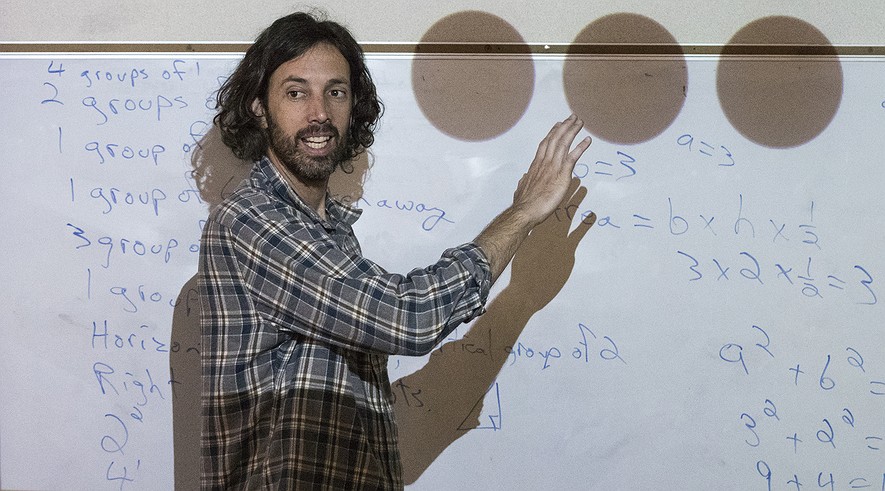
Teacher David Hicks uses "dot talks" while teaching eighth-grade students math at San Francisco 49ers Academy in East Palo Alto, California, Feb. 25, 2015. Hicks has students do "number talks" and "dot talk," employing oral and visual aids to help students overcome math anxiety. Photo: John Green/Bay Area News Group/TNS

SAN JOSE, Calif. — Do you hate math? Relax — the problem may not be you, but rather the way math is taught.

Fear of math represents not personal failure or a missing gene but wrongheaded “one-size-fits-all” ways of teaching. So, at least, runs the theory behind a quiet revolution in math education that is exciting teachers nationwide.

More and more math instructors are embracing ideas developed by two Stanford professors who set out to reform math instruction. Their approach includes more visual and creative exercises, discussions of ideas rather than a focus on memorization and speed, and individually tailored lessons.

Math Horror Stories

Mention to people that you teach math, David Foster of the Silicon Valley Mathematics Initiative said, and they all “launch into a horror story about high school math. The only mystery is if they blame the algebra teacher or the geometry teacher” for their hatred of math.

Foster, whose organization offers training and resources for teachers, advocates a more positive approach to get kids to love learning.

“Learning to do math is no different from learning to play the piano or learning to play a sport — a lot of it is about hard work and practice.”

Learning From Failure

That idea is rooted in the work of psychology professor Carol Dweck and education professor Jo Boaler, whose approaches to teaching math are spreading quickly. Dweck has found that failure helps students to learn, grow and get better. She urges that math education focus on helping students persevere even if they do not succeed at first.

Boaler offered a free online math course last summer that attracted 85,000 people. Her approach involves less memorization; instead, lessons focus on different ways to solve problems, individualized approaches, small-group discussion and real-life applications of math. Also feeding the teaching revolution is an explosion of online math lessons replacing lectures and one-size-fits-all textbooks.

“We’re in a crisis in math,” Boaler said. “These poor kids are given the idea that math is about performance, and then they get the idea that they can’t do it.”

As Sahib Dokal, a sixth-grader at Piedmont Middle School in San Jose, put it: “It feels like you have to do it faster and I can’t think that hard.”

Program Recognizes Effort

Teachers say that bad classroom experiences with math have led to math failure. Just 36 percent of U.S. eighth-graders score at their grade level on national math tests.

To underline the importance of effort, the Khan Academy — an educational organization that provides free education through video lectures on YouTube — has launched a math contest that recognizes not just mastery, but effort as well. The LearnStorm challenge posts weekly scores and has attracted 41,000 students from the Bay Area.

“I thought I would bring a little more excitement to my students,” said David Hicks of San Francisco 49ers Academy in East Palo Alto, which was in first place in effort, or “grit,” after the contest’s first week last month. The contest tallies student progress in mastering Khan Academy lessons. A computer program gauges each student’s work and tailors lessons to their level. Thus, Hicks said, in his mixed-level class, “my algebra students don’t have to wait for my students who are at a third-grade ability.” Khan’s “dashboard” shows each student’s progress, level, struggles and effort.

“When I complete it, it makes me feel smart,” 49ers eighth-grader Fernando Ibarra said.

Good-Teaching Basics

Online tools do not work for everyone, however. Ana Wallace, a senior at Summit Rainier in San Jose, finds Khan’s video lessons confusing. “You can’t ask Khan questions,” she said, and the daily 30 minutes on Algebra II and other subjects just get her more confused.

There are other approaches. Hicks at the 49ers Academy does number talks, often by posing a puzzle-like question, and illustrating on the whiteboard students’ step-by-step thinking as they solve the problem. “How does counting by 4s relate to multiplication?” a teacher might ask, in deconstructing a math procedure to help students understand.

However, much of what makes math more accessible comes down to just good teaching: keeping track of each student and not leaving anyone perplexed.

Michelle Rojas, 12, said she hated math in elementary school, and when she asked a question, teachers “explained it in their own college way, instead of for the grade level you were in,” she said. Now a sixth-grader at Alpha Blanca Alvarado Middle School in San Jose, she is understanding lessons.

Transforming The Math-Learning Disability

Teachers and students say that relating math to everyday problem-solving and daily life is also important.

“The more you can connect the math to their life,” the better, said math teacher Mona Keeler. It makes it meaningful and "takes off that pressure."

What is the evidence that these new ways work? So far there are only small-scale reports, individual school tests and plenty of stories from teachers themselves.

“I’ve seen humongous growth” in math achievement, Keeler said.

So with cheerleading teachers, can everyone learn trigonometry and calculus?

“Most of humanity is capable,” Khan Academy founder Salman Khan says firmly. He points to humankind’s strides in literacy: 400 years ago, only a small number of people could read, whereas today three-quarters of the world's population can.

What about those with a math-learning disability?

“It’s hard to know who’s born with a math disability, or who becomes disabled because of the way they’ve been treated in math,” Boaler said. “I know we can transform it. We can have kids loving math.”